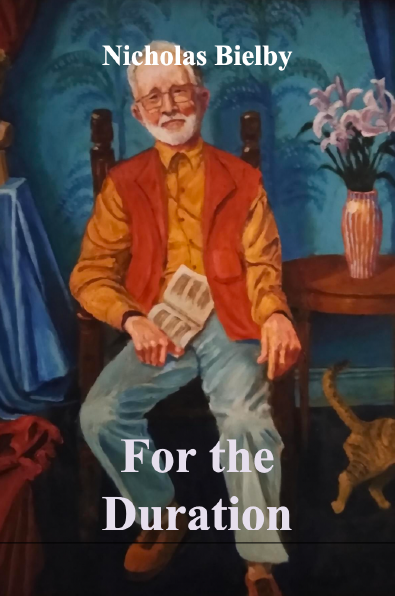
For The Duration
Nicholas Bielby
- ISBN:978-1068602917
- Format:Paperback
- Published:August 2025
- RRP (UK):£10.00 + P&P £2
This latest book from Nicholas Bielby, an Arvon International prize-winning poet, contains mostly new and some recovered poems, e.g., from an obsolete Amstrad! It includes his “Ode to Himself”, reflections on himself on reaching eighty-five, a long, possibly controversial poem on reading the Qur’an, and a distinctly controversial poem on “trans-women are women.”
Nicholas Bielby went from grammar school in Huddersfield to Cambridge, and then to teach in India. After that, he spent most of his working life in teacher education. After retiring from Leeds University, he was editor of the poetry magazine, Pennine Platform, for 15 years. He has written four academic books and five previous books of poetry and has won numerous prizes in competitions, including the Arvon International and New Poetry.
Many of Nicholas Bielby’s poems are among the finest being written today… Each poem is more than its subject, each is a work of art in which the elements of life and language have undergone, like a chemical reaction, a transformation into something rich and strange.
- Anne Stevenson
The pleasures (his) poems offer the reader are quiet, subtle and substantial, and all the more real and lasting for their innate honesty and modesty before their subjects.
- Dick Davis
Bielby has enriched English poetry throughout his life-long attention to the art. Plums has the hallmarks of his craft in its studied formal assurance, its wide-ranging consciousness and its deep historical knowledge... Throughout the poems, there is a well of sympathy for humanity’s Job-like capacity to endure. This sympathy is felt in poems both personal and philosophical, but linked to ageing now in ways that are profoundly moving.
- Jefferson Holdridge
The fallen ash tree
A fountain of blond chips as the chainsaw
eases its way down through the fallen trunk
which has lain for two nights like a humped whale
along the hedge and dry stone wall. Lost bees
hunt among the sections for their sweet home.
A woodpecker hole lies on the ground face down.
What of the owls who, last night, complained
in the gloaming as we studied its prostrate bulk?
Long ago, shed branches had opened up wounds.
The bole had rotted, hollow as a drum
with walls three inches thick. The winter gales
had twisted, split it, but it still stood tall.
And now in spring, the bright new foliage,
tugged by light airs, has toppled it headlong.
Kisses for my Mrs
Now married nearly sixty years,
should we try counting up, my love,
all our kisses - and all the wheres
I've kissed, not to be spoken of?
We've been together more than twenty
thousand days (and nights) and, yo,
each day, we've kissed and kissed aplenty -
let kisses multiply! But no,
shun number, weight and measure - this is
no time of dearth. So, like Catullus,
we'll have no counting of our kisses
in case the envious envy us.
Or let that busy old fool, the sun,
tot up the score, while we are better
employed in adding kisses on
like compound interest to a debtor.
However many times the sun
has risen on us in bed, its light
is only one brief flicker in
deep time, before perpetual night.
We are the old Catullus warned of,
whose thoughts are hardly worth a penny.
Well, he's well dead. We won't be warned off
still adding muchly to the many!
Writing as serendipity
John Constable thought of paintings as
experiments. And so I think it is
with poems - they may not work, or may
say what you don't know that you want to say.
I like to work in form and rhyme which then
constrain expression with their discipline
and push forward to conclusion - although
what (or if) that might be, you don't know.
It sometimes happens that a word you find
while searching for a sound to match a sound,
pulls, by happy chance, the poem askew
in new directions, making all things new.
You hope for that! If stuck you might look back
to the beginning for a phrase (a trick
I learnt from Yeats) you can reprise and use
to help to shape an ending. So now let's choose -
When the experiment comes to its end,
you don't know that it has until it's found:
a something understood, as a surprise
that feels it could not have been otherwise.
Nothing anywhere can keep from dancing
after Rilke's Orpheus Sonnets, II: 28
You, almost a child still, come and go,
become for a moment a figure in
the constellation of pure dance - you can,
for the blink of an eye, transcend the flow
of the ordinary order of things. For you
are only completely yourself when moved,
moving to Orpheus' song. As a child, you lived
those feelings - surprised that trees were so slow
to join you in the dance! You know again
that place where the sounding lyre was played -
the unheard centre. Answering that, you assayed
those lovely figures - and even hoped to turn
yourself, your face, direction of travel,
to celebration of what makes us whole.
© 2025 Nicholas Bielby